Devlog · Nov 16
1. Peektrace now runs on Rust: v0.13.0 is out
Peektrace is a local inspector for Claude Code, Codex, Pi and OpenCode sessions. Last entry, its Rust rewrite was 10 open PRs on an experimental branch. Since then I added the last pieces and deleted the TypeScript CLI, core, server and desktop app. The 22-PR stack merged this morning and shipped as v0.13.0. The commands, flags and output are the same as in 0.12.0. Release numbers, TS → Rust:
sessions ls, all agents: 1639 ms → 135 ms, peak memory 1158 → 32 MiBsessions search: 2024 ms → 114 msstatusline, which Claude Code runs on every turn: 118.4 ms → 4.5 msstats, empty cache: 23.4 s → 3.7 s- Server peak memory: 1736 → 366 MiB
- TUI scroll step on a 47 MiB session: 61.1 ms → 3.7 ms
The browser UI stays React, but it now takes its types from Rust: ts-rs generates them from the exact JSON the server sends, and a test fails on any extra or missing key. Stack: #171
2. A native Peektrace app on Rune
The desktop app was a 145 MiB Electrobun bundle, and about 74% of it was two copies of Bun. It is now a native Rust app on Rune, a GPU UI framework. Four PRs ported every screen: sessions with the growth chart, Stats, Settings, Capabilities and Memory with its link graph. On a Mac M1 Max:
- App size: 145.5 MiB → 25.2 MiB
- Session list, 837 real sessions: 171 ms
- Open a 48 MiB session: 281 ms. Scrolling it costs 0.9 ms of CPU per frame (p95 3.6 ms)
- Stats, Settings and Memory show 1.4–6× faster than in the browser inspector on the same data
Rune also builds for the web, but there it needs WebGPU, downloads 8.4× more and shows the session list 1.5× slower. So the browser keeps the React inspector, and Rune is native only. Packaging the app for release is the next step. #184
3. Big sessions load in pages in the Peektrace inspector
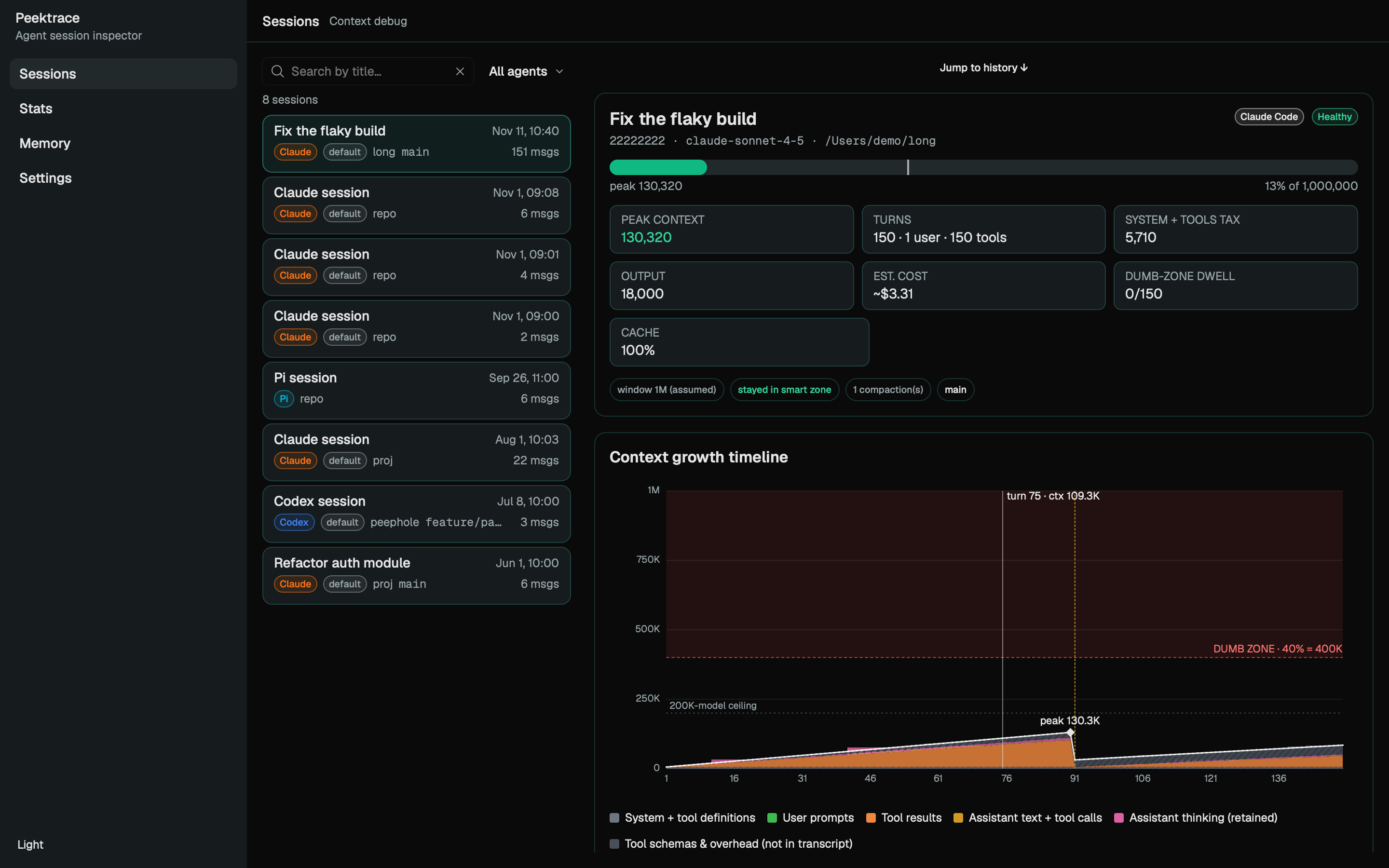
Opening a session in the browser used to download its whole analysis before the first row drew. Now the server splits it into a summary, the chart series, a body-free index of every event, and pages of 100 events. Sorting, filters and search run on the index, and bodies load as rows scroll into view. On a synthetic 49 MB session:
- First row drawn: 844 ms → 480 ms
- Bytes received by then: 4.13 MiB → 768 KiB
The cost: scrolling a real 48 MiB session from top to end takes 20% longer, because bodies arrive during the scroll. #185
4. One keyboard focus ring for every control in ThinkRail
Keyboard focus looked different on every control. The chat composer only changed its border colour, which scored APCA Lc 8 or less against its surroundings. APCA is the contrast model behind the WCAG 3 drafts, and a UI indicator needs Lc 45. 96 class strings drew their own focus styles. Now one focus-ring utility replaces all of them, and a base :focus-visible rule gives any control without one the same ring instead of the browser's blue default.
- Composer focus contrast: Lc 8 or less → at least 49.4 in all 6 themes
- Hand-written focus styles: 96 → 0. A test fails if a new one appears.