Devlog · Nov 17
1. Session costs in Peektrace now match what the agent billed
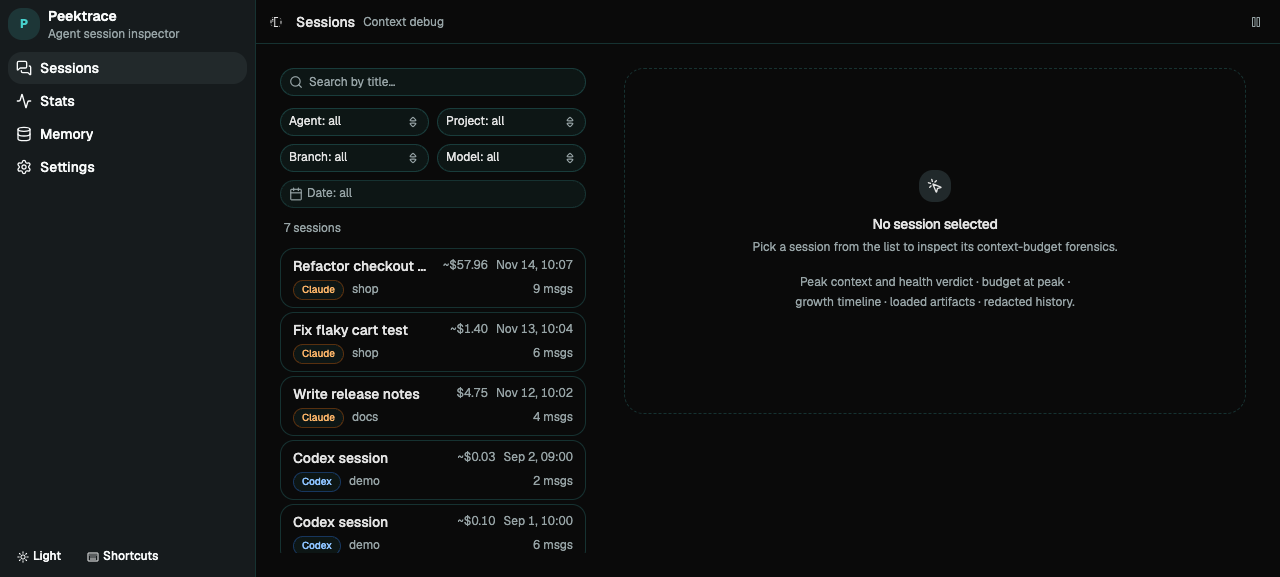
Peektrace estimated each session's cost from its tokens. That missed a lot. A model with no price card counted as $0, so a session Claude Code billed at hundreds of dollars showed a few. The session list read only the main transcript and skipped the subagent files, so subagent-heavy sessions looked 10–50× cheaper than in their own detail view. Codex rows showed no cost at all.
Claude Code already writes its own billed total into the transcript (cost-state). Peektrace now shows that number when it covers the session, and keeps its token estimate as the fallback and the breakdown. The list and the detail now get their cost from the same function. On my 278 Claude sessions with a full record:
- Sessions within 5% of the billed cost: 217 → 278
- Session list total for Claude, 728 rows: $3,143 → $12,939, the same as the detail views
- Codex rows with a cost: 0 → 42 of 47
Prices now come from models.dev, and peektrace pricing update downloads new rates without waiting for a release. All of this is on main and goes into the next release. The cost: listing every session takes 80 ms longer (146 → 226 ms). #204 #207 #208
2. Peektrace lint moves from Biome to oxlint, with type-aware rules
Biome has no type-aware rules, so unsafe any flows, unexplained type assertions and truthiness checks on nullable numbers all passed. The TypeScript side of Peektrace now runs oxlint and oxfmt through Ultracite 8, with type-aware checks and its anti-slop rules. The test folders were outside every tsconfig, so typecheck never checked them. Now it does.
- Lint errors under the new config: 4,663 → 0
- Typecheck: tests not covered → covered
- Tests: 501 pass before and after
Most errors were fixed by the formatter and --fix, and 1,020 by hand. Two review passes found four behaviour changes, all from the sort-keys autofix and one refactor, and fixed them. A side-by-side run of both builds on 845 real sessions showed the same text on every page. #201
3. Faster Rust CI with kache
Rust CI cached the whole target/ folder per job. When Cargo.lock or the toolchain changed, the whole cache was thrown away. kache wraps rustc and stores each crate's output by content hash, so a crate restores whenever its inputs match. Warm runs:
- Linux check: 100 s → 67 s
- macOS check: 174 s → 84 s
- Rune UI job: 208 s → 171 s
Windows got slower, 173 s → 190 s: kache passes 189 of its rustc calls straight through. #193