Open source · Solo project
Recruit AI: Intelligent Recruitment Matching
Jobs find candidates. Candidates find jobs. One score, both ways.
An open-source hiring marketplace where the ranking is the product: jobs surface the right candidates, candidates surface the right jobs, and both sides are scored by the same rules. Built as a reference for search that gets measured instead of guessed at.
- Type
- Open source, public repo
- Architecture
- Hexagonal ports and adapters on Effect.ts
- Stack
- TypeScript end to end, Qdrant, PostgreSQL
- Status
- Built and public, eval framework waiting on labeled data










01
Inside the build
Retrieve and rerank
The pipeline is the pattern search engines and recommenders use: retrieve a wide set fast, then spend the expensive scoring on that set only. Qdrant returns the top 50 by approximate nearest neighbor, and a multi-factor model re-ranks those to the top 10.
Retrieval runs under the hard constraints first. Work mode, location and relocation are payload filters Qdrant applies before the nearest-neighbor step. Vectors are 3072-dimensional Gemini embeddings, indexed with HNSW and compared by cosine distance, so search stays sub-linear as the candidate pool grows. HNSW exposes m and ef_construct at index time, which is where the precision and recall tradeoff actually gets set.
Re-ranking combines four signals: semantic similarity carried over from retrieval, keyword recall between extracted skills and stated requirements, experience fit on years and seniority, and soft constraints such as salary range and start date. One function scores job→talent and talent→job. Both sides of the marketplace are ranked by the same rules, so the two directions cannot drift apart.
Measuring the ranking
The weights are a deliberate starting point, not a tuned result. NDCG@10 is the primary ranking-quality metric, and the eval framework is built to tune against it as soon as recruiter-labeled ground truth exists. The eval groups cover each layer:
Component evals
- LLM extraction: field-level accuracy and keyword F1 for resume and job-description parsing, compared across providers
- Embedding models: Recall@10, MRR, and the separation gap between good and poor matches
- Retrieval quality: filter correctness, eligible-candidate recall, and latency across vector database options
Scoring and end-to-end evals
- Weight optimization: grid and Bayesian search over weight combinations, scored by rank correlation with recruiter preferences
- Factor ablation: what NDCG@10 does when a single scoring factor is removed
- Agent-driven discovery: an agentic loop that rewrites the scoring function toward a target metric
- Full pipeline: system rankings against recruiter-preferred orderings
The framework follows Anthropic's methodology of tasks, trials and graders, with a strict split: dev sets (60%) for iteration, held-out test sets (40%) for the final comparison. Deterministic code graders cover objective accuracy, LLM rubric graders cover the subjective part.
From uploaded file to searchable record
An LLM turns a resume into skills, experience, preferences and constraints, and a job description into requirements, responsibilities and qualifications. Where something is missing it asks a follow-up question instead of guessing. Every processed record is embedded and indexed automatically.
Hexagonal architecture
Core domain
- Pure scoring functions: the matching logic is plain testable functions with no Effect dependency
- Domain models: typed definitions for talents, jobs and matches
- Ports: service boundaries declared as Effect Context Tags
Adapters
- PostgreSQL: Drizzle ORM, type-safe migrations
- Qdrant: vector search with payload pre-filtering on the hard constraints
- AI: Gemini 2.0 through the Vercel AI SDK, for both extraction and embeddings
Effect.ts carries this beyond convention. Services are Context.Tag, so the type system rejects a program until every dependency is provided: missing wiring is a compile error, not a 3am runtime one. Every failure mode is a discriminated union rather than a thrown exception, which means the compiler lists the cases you have not handled. @effect/rpc carries the same schemas across the frontend and backend boundary, validated on both sides.
Monorepo
Turborepo and Bun, split so each package has one job:
- apps/web: Next.js frontend with shadcn/ui
- packages/core: domain models, ports, scoring
- packages/db: Drizzle schema, migrations, PostgreSQL adapters
- packages/vector: Qdrant integration
- packages/ai: model and embedding providers via the Vercel AI SDK
- packages/api: Effect HTTP API layer
- packages/ui: shared components
- packages/env: environment validation
Stack
Gemini 2.0 Flash does the structured extraction and the clarifying questions. Gemini embeddings produce the 3072-dimensional vectors. TypeScript runs in strict mode across every package, with Ultracite over Biome for linting.
02
Related work
Outrizz AI: Event Engagement Platform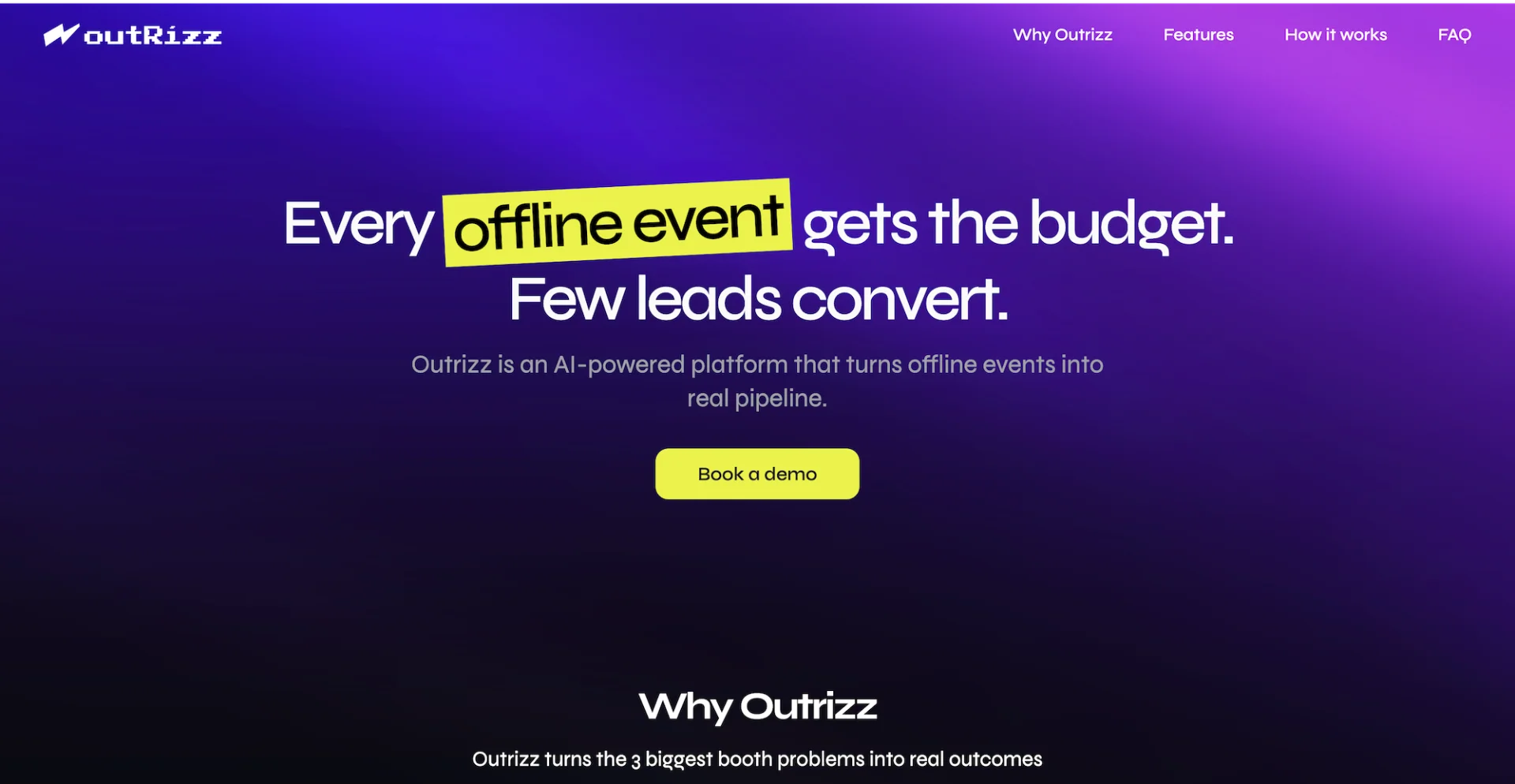
30K+leads generated
Outrizz AI: Event Engagement Platform
An event marketing platform for B2B sales teams. It finds the right people before a trade show and talks them into coming, then captures everyone who stops at the booth and follows them up while the event is still running.
Next.jsReact NativeAItRPCTurbo MonorepoDrizzleSupabase
View Project
PickArt: Art-Hospitality Marketplace Platform
15Kmonthly active users
PickArt: Art-Hospitality Marketplace Platform
A marketplace that puts artists' work on hotel walls and lets guests buy the piece they are looking at: hosts get free curation, artists get a sales channel, guests take the art home.
Next.jsTypeScriptSupabaseStripeReact PDFNext-intlDrizzleTanStack Query
View Project
Intelligent Aggregator Platform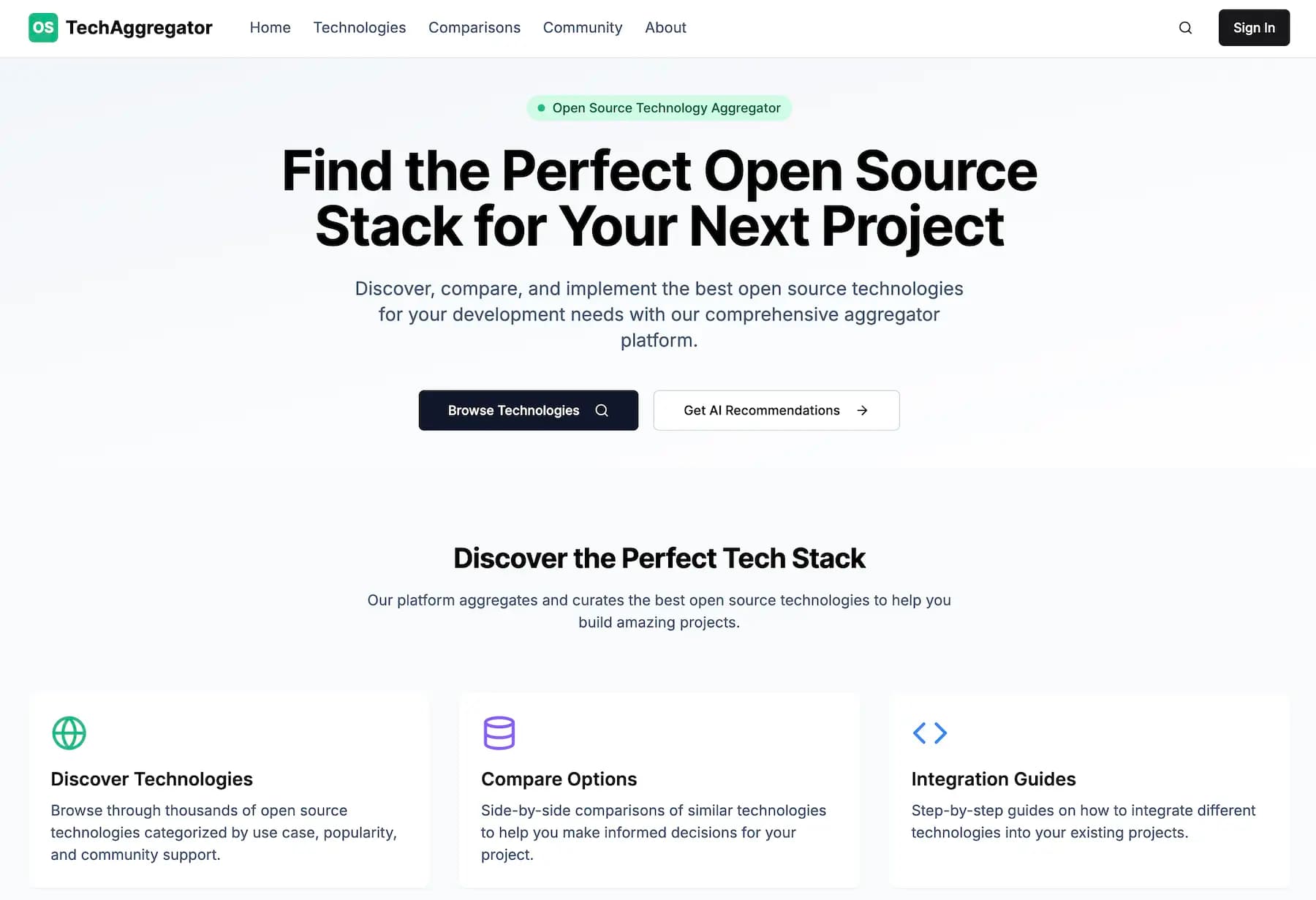
Intelligent Aggregator Platform
A catalogue of B2B software where buyers ask a question in plain English and get an answer back from the live listings, instead of clicking through category pages.
Next.jsTypeScriptSupabaseOpenAITailwind CSSZodDrizzle
View Project
Need AI search that can be measured?
If retrieval, ranking or matching sits at the center of your product, I can build the pipeline and the evals that tell you it actually works, on architecture that lets you swap the pieces later.
Book a free call30 minutes, free. You leave with a plan either way.